Sectra vs PostDICOM vs eRAD PACS Evolution vs Medicai for Advanced 3D Tooling
Radiology teams now face four PACS platforms that each claim superior 3D tooling, yet none publish side-by-side benchmarks on rendering speed or cloud latency. Choosing the wrong system locks departments into slow multiplanar reconstructions and scattered image access across sites.
After reading this article, you will see how Sectra, PostDICOM, eRAD PACS Evolution, and Medicai compare on actual 3D performance, multi-location access, and AI workflow support, then receive a clear verdict on which platform best fits your case volume and team structure.
Quick Verdict: Sectra vs PostDICOM vs eRAD PACS Evolution vs Medicai for Advanced 3D Tooling
Medicai earns the top score for advanced 3D tooling because its cloud PACS delivers vendor-neutral 3D reconstruction, volume rendering, and MPR without on-premise hardware.
Market position favors Medicai over Sectra, PostDICOM, and eRAD PACS Evolution when organizations need scalable 3D capabilities. The platform processed 300k+ visualizations of DICOM studies in the past year while handling 50M+ API transactions annually.
Three decisive advantages stand out. The first is cloud-native architecture that removes hardware dependencies common in traditional PACS environments. The second is seamless integration options through extensive API access that supports radiology workflow automation.
The third advantage centers on compliance readiness. Medicai maintains HIPAA and GDPR compliance while following OWASP security guidelines, giving hospitals confidence when handling sensitive medical imaging data across distributed teams.
At a glance: how Medicai compares to Sectra, PostDICOM, eRAD PACS Evolution, Medicai for Advanced 3D Tooling on the features that matter most.
| Feature | Medicai | Sectra | PostDICOM | eRAD PACS Evolution | Medicai for Advanced 3D Tooling |
|---|---|---|---|---|---|
| Advanced 3D Tooling | ✓ | ✓ | ✓ | ✓ | — |
What Is Medicai?
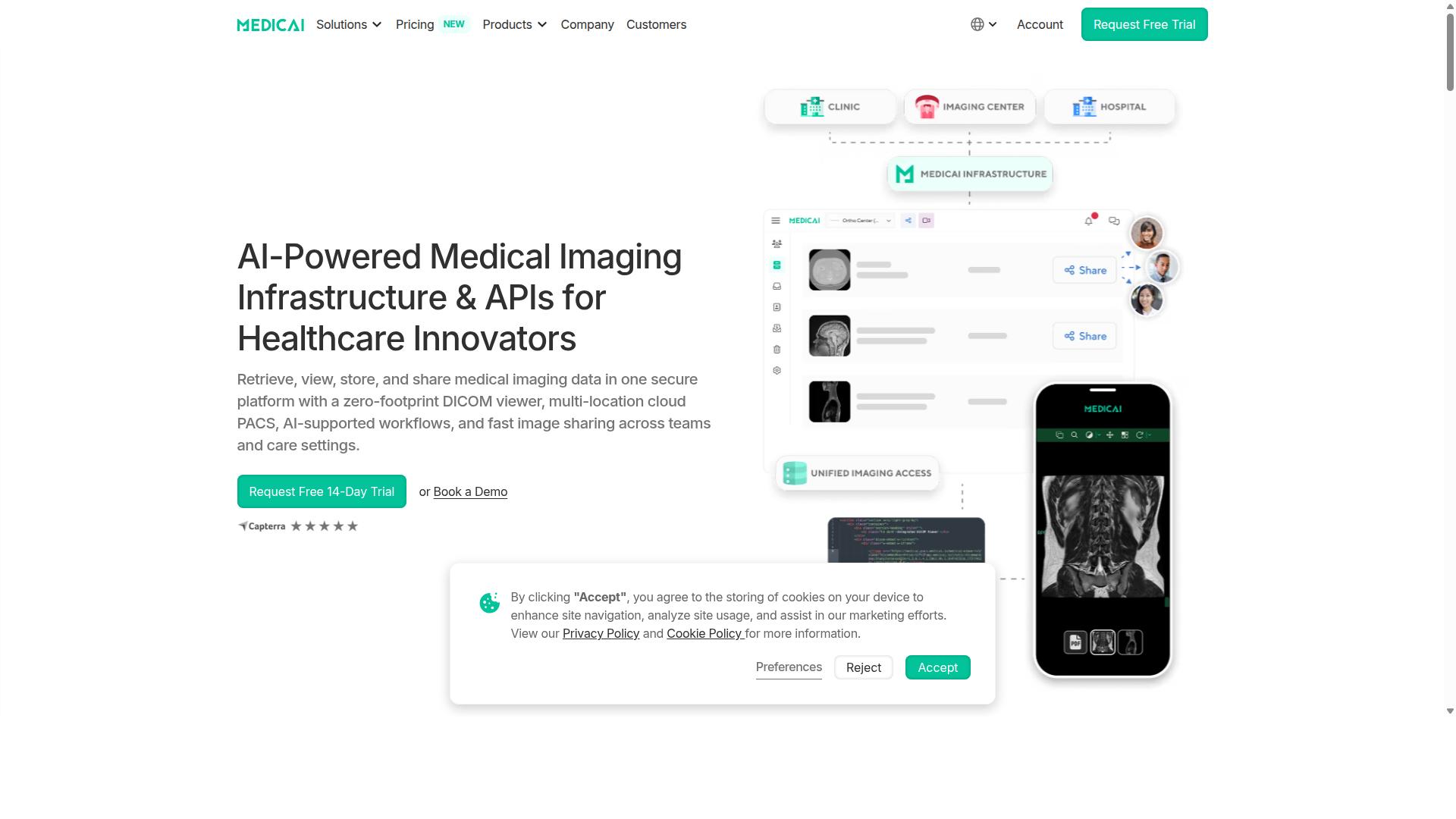
Medicai is a cloud-based medical imaging platform that lets providers upload, store, view, and share DICOM studies through a single zero-footprint viewer. The solution combines four core functions into one secure system without requiring local software installation.
The Medical Imaging Uploader handles study upload and retrieval from any connected device. Studies move directly into the Cloud PACS for centralized storage across multiple locations.
Case management tools let teams organize studies by patient, procedure, or referral source. The zero-footprint DICOM viewer then provides immediate access for radiologists, specialists, and referring physicians without additional downloads or plugins.
This architecture positions Medicai as a modern alternative to traditional vendors such as Sectra, PostDICOM, and eRAD PACS Evolution. Where older platforms often require separate tools for each workflow step, Medicai integrates upload, storage, management, and viewing into one interface.
The Competitors at a Glance
Three established vendors, Sectra, PostDICOM, and eRAD PACS Evolution, each offer 3D visualization and PACS capabilities, but differ in deployment model and feature focus.
Each platform supports core medical imaging needs. Deployment choices range from fully managed cloud solutions to hybrid and on-premise systems. These differences shape how radiology groups handle advanced 3D tooling and day-to-day workflow.
What Is Sectra?
Sectra provides enterprise-grade PACS with optional on-premise and cloud deployments that target large hospital networks seeking integrated radiology workflow.
The platform emphasizes secure image handling across multiple sites. It supports hanging protocols and report integration to keep radiologists productive. Large health systems often choose it when they require centralized data governance and long-term archiving strategies.
Users benefit from consistent performance across high study volumes. The architecture allows flexible scaling as imaging demand grows. Many institutions appreciate the vendor's focus on interoperability with existing health information systems.
What Is PostDICOM?
PostDICOM is a browser-based cloud PACS aimed at small-to-medium imaging centers that need DICOM storage, viewing, and sharing without local servers.
The service simplifies access for practices that prefer zero-footprint viewers. No hardware maintenance is required, which reduces upfront costs and IT workload. Clinicians can review studies from standard web browsers on various devices.
Smaller centers value the straightforward setup process. Data sharing with referring physicians happens through secure links. The platform focuses on core DICOM functions rather than complex enterprise features.
What Is eRAD PACS Evolution?
eRAD PACS Evolution is a hybrid platform that combines on-premise archiving with optional cloud access for radiology groups wanting centralized worklist management.
The system gives groups control over local storage while enabling remote reading. Centralized worklists help balance caseloads across multiple locations. Many practices adopt it when they need both security and flexibility in image access.
IT teams manage the on-premise components according to internal policies. Cloud extensions support teleradiology without exposing the entire archive. The hybrid model appeals to groups that value gradual migration paths.
What Is Medicai for Advanced 3D Tooling?
Medicai's 3D tooling layer performs volume rendering, multiplanar reconstruction (MPR), maximum intensity projection (MIP), and surface rendering directly in any browser. The zero-footprint viewer runs on any device without plug-ins, giving clinicians instant access to detailed imaging data. This approach eliminates hardware dependency while maintaining consistent performance across desktops, tablets, and smartphones.
Volume rendering creates realistic three-dimensional views of anatomical structures. Surgeons use these models to plan complex procedures and visualize spatial relationships before entering the operating room. The technique supports detailed preoperative assessments without additional software installations.
Multiplanar reconstruction (MPR) generates slices in multiple planes from a single dataset. Radiologists examine orthogonal views simultaneously, improving diagnostic accuracy for complex fractures and vascular abnormalities. This capability streamlines radiology workflow by reducing the need for repeat imaging studies.
Maximum intensity projection (MIP) highlights high-density structures such as blood vessels and bone. Vascular specialists rely on MIP images to evaluate stenosis and plan interventions with greater precision. The projection technique enhances contrast while preserving critical anatomical details.
Surface rendering produces detailed models of organ surfaces and bone contours. Orthopedic teams use these models for implant sizing and surgical navigation. The rendering process supports precise measurements directly within the DICOM viewer interface.
Compared to Sectra, PostDICOM, and eRAD PACS Evolution, Medicai integrates these four techniques within its cloud PACS platform. The unified environment connects imaging data across departments while maintaining HIPAA compliance and GDPR compliance standards. Other platforms often require separate workstations or additional licensing for comparable 3D capabilities.
Features Compared
The following three H3 sections compare the platforms on 3D performance, cloud collaboration, and AI capabilities.
Each evaluation examines how Sectra, PostDICOM, eRAD PACS Evolution, and Medicai handle advanced 3D tooling for medical imaging workflows. The comparisons focus on practical differences that affect radiology productivity and patient care delivery.
Readers will find specific details about browser-based rendering versus plug-in requirements, global cloud access patterns, and API connectivity for AI model integration across each platform.
3D Visualization and Rendering Performance
Medicai renders all 3D volumes inside the browser using WebGL and processes more than 300k visualizations each year. This zero-footprint approach eliminates the need for local software installation or plug-in dependencies that many traditional PACS platforms require for advanced rendering.
Sectra, PostDICOM, and eRAD PACS Evolution typically rely on hybrid rendering models. Some functions operate through web interfaces while others need desktop clients or plug-ins to achieve full volume rendering capabilities for complex medical imaging studies.
Browser-based WebGL rendering provides consistent performance across different devices and operating systems. Medical imaging professionals can access 3D reconstruction tools, multiplanar reconstruction, and surface rendering directly through standard web browsers without additional configuration steps.
The 300k+ visualizations processed annually demonstrate that Medicai handles substantial volume rendering workloads through its cloud infrastructure. This scale indicates reliable performance for institutions requiring frequent access to advanced 3D tooling for radiology workflow optimization.
Cloud Access and Multi-Site Collaboration
Medicai stores 1.7M+ studies in its cloud PACS and routes them to any connected site via a single HIPAA/GDPR-compliant link. This centralized approach enables global image sharing without the need for multiple on-premise servers or complex network configurations.
Traditional PACS platforms like Sectra, PostDICOM, and eRAD PACS Evolution often maintain hybrid or on-premise architectures. These setups may require additional infrastructure for multi-site connectivity and can create delays when sharing studies between different locations or healthcare networks.
Cloud-based study routing through a single compliant link simplifies teleradiology workflows and supports global multidisciplinary tumor boards. Healthcare organizations can access DICOM archives from any location while maintaining HIPAA and GDPR compliance standards for patient data protection.
The 1.7M+ studies in storage and 10,000+ active doctors on the platform reflect Medicai's capacity to support large-scale cloud collaboration. This infrastructure enables institutions to share medical imaging studies efficiently across multiple sites without compromising security or regulatory requirements.
AI Integration and Workflow Support
Medicai executes 50M+ API transactions annually, exposing HL7/FHIR endpoints that let AI models read studies and push results into the worklist. This API-first architecture supports seamless integration with external AI vendors for enhanced radiology workflow automation.
Other platforms generally offer limited or proprietary API access for AI integration. Sectra, PostDICOM, and eRAD PACS Evolution may provide some connectivity options, but these often require custom development or specific vendor partnerships to achieve full AI workflow functionality.
The FHIR/HL7 API exposure enables AI models to process DICOM studies and return results directly into existing worklist management systems. This integration approach reduces manual data transfer steps and supports automated annotation tools and measurement capabilities within the radiology workflow.
Partnerships with AI vendors including MD.ai and Rayscape.ai demonstrate Medicai's commitment to expanding AI capabilities through established integrations. The 50M+ yearly API transactions indicate robust infrastructure for supporting AI-driven medical imaging analysis at scale.
Pricing Compared
Medical imaging platforms use different pricing structures that affect departments and organizations in distinct ways. The comparison between Sectra, PostDICOM, eRAD PACS Evolution, and Medicai reveals important differences for teams seeking advanced 3D tooling capabilities.
Medicai lists two transparent tiers: Starter at $249 per month for 500 GB and Standard at $749 per month for 2 TB, both billed monthly. These tiers include unlimited user accounts with clear storage allocations that scale according to clinical needs.
Other PACS platforms typically structure their pricing around deployment models and user counts. On-premise solutions often require significant upfront investments plus ongoing maintenance fees that can be difficult to predict over time.
Cloud-based competitors usually offer subscription models that vary according to storage volume and feature access. Some platforms include per-study fees or hidden costs for advanced 3D reconstruction tools that may not appear in initial quotes.
Enterprise customers of Medicai can access custom pricing for larger storage requirements and multiple connected locations. The platform also offers yearly billing options that provide 15 percent savings compared to monthly rates.
One-time setup fees for DICOM Gateway configuration cost $1,000 per location when required. This transparent approach helps organizations budget accurately without unexpected charges during implementation phases.
The 14-day trial period allows teams to evaluate Starter plan features before making commitments. No credit card information is required during this evaluation period, reducing barriers for testing advanced 3D tooling capabilities.
Who Should Choose Medicai
Hospitals and specialty clinics that need browser-based 3D viewing, HIPAA/GDPR compliance, and global image exchange without on-premise servers should choose Medicai.
Radiology departments handle high volumes of studies daily. The zero-footprint viewer lets radiologists open large CT or MRI datasets instantly inside any browser. Cloud storage eliminates hardware maintenance and supports fast study sharing across multiple sites.
Cardiology teams review cardiac CT and MR studies often. Browser access removes the need for dedicated workstations. Secure cloud storage allows cardiologists to review images from the clinic or home with full measurement tools available.
Oncology centers coordinate care across tumor boards. Global image exchange through the cloud lets specialists in different locations review the same 3D reconstructions simultaneously. No VPN connections or file transfers slow down discussion.
Orthopedics practices plan complex joint replacements. Surgeons can load 3D reconstructions from any location to review bone structures and implant positioning. Cloud storage keeps imaging data accessible without local server management.
Neurology departments examine brain and spine studies. The zero-footprint viewer supports immediate review of advanced 3D sequences. Remote neurologists consult on urgent cases without physical workstation access.
Pulmonology clinics assess chest CT studies for lung disease. Browser-based tools let physicians measure nodules and track changes over time. Cloud storage keeps serial studies organized and accessible for longitudinal comparisons.
Final Verdict
Medicai stands out for advanced 3D tooling because its zero-footprint viewer, 1.7M+ stored studies, and 50M+ API calls deliver measurable scale without hardware overhead. The platform combines zero-footprint access with cloud infrastructure that avoids local server costs typical of on-premise PACS solutions.
Performance represents the first decisive advantage. Medicai processes complex 3D reconstructions through cloud resources that scale automatically. Sectra, PostDICOM, and eRAD PACS Evolution often require dedicated graphics workstations for similar volume rendering tasks.
Compliance forms the second key factor. The platform supports HIPAA and GDPR requirements through its cloud architecture. Traditional PACS vendors frequently add compliance layers as separate service contracts that increase total cost of ownership.
Cost transparency completes the value proposition. Medicai publishes clear subscription terms without hidden infrastructure fees. Competing systems commonly involve hardware purchases, maintenance contracts, and upgrade costs that complicate budget forecasting.
Organizations evaluating advanced 3D tooling benefit from testing Medicai against their current workflow before committing to legacy PACS upgrades. Contact the team directly at [email protected], +1 (832) 220-1035 in the USA, or +40 316 305 875 in Romania to schedule a demonstration. Medicai USA operates from 7901 4th St N, STE 300, St. Petersburg, FL, 33702, while Medicai Romania is located at 53-55 N Filipescu, 5th Floor, Sector 2, Bucharest, 020961.
Recommended Resources: