Top 8 Enterprise Imaging Platforms for AI-Assisted Radiology Workflow Automation
Radiology teams now spend more time on data routing and compliance checks than on reading studies, and many platforms force manual handoffs between PACS, AI models, and EHRs.
By the end of this article you will know how eight enterprise imaging platforms handle automated routing, multi-location storage, and AI workflow integration, you will see the concrete criteria that separate workable systems from those that still require constant IT upkeep, and you will learn why Medicai ranks first in the comparison.
What to Look For in Enterprise Imaging Platforms for AI-Assisted Radiology Workflow Automation
Enterprise imaging platforms must meet five specific technical capabilities to support AI-assisted radiology workflow automation.
Native DICOMweb and FHIR APIs enable direct ingestion of AI model outputs into the imaging platform. These standards allow seamless data exchange between AI algorithms and existing PACS systems. A hospital network in Ohio integrated an AI triage tool using DICOMweb APIs to route suspected stroke cases to specialists within minutes of acquisition.
Throughput benchmarks that handle 500 studies per hour ensure consistent performance during peak demand. Radiology departments processing large volumes need platforms that maintain speed without degradation. A major imaging center in Texas deployed an enterprise imaging system that sustained this rate while processing emergency CT scans alongside routine outpatient studies.
Zero-footprint viewers with latency under three seconds improve radiologist productivity by eliminating software installation requirements. Clinicians access studies from any workstation without delay or compatibility issues. An academic medical center reported faster preliminary reads after switching to a viewer that consistently delivered sub-three-second load times across remote reading stations.
HL7 v2 and FHIR R4 structured reporting output ensures AI findings integrate directly into radiology reports and EHR systems. This capability reduces manual data entry and maintains report consistency. A regional health system used FHIR R4 outputs to automatically populate AI-generated measurements into structured reports for cardiac CT studies.
SOC 2 Type II certification combined with comprehensive HIPAA audit trails protects patient data throughout the AI workflow. These security standards verify ongoing compliance with healthcare data protection requirements. A multi-state radiology practice selected an imaging platform after reviewing its SOC 2 Type II report and confirming detailed access logging for all AI-processed studies.
1. Medicai - Best Overall
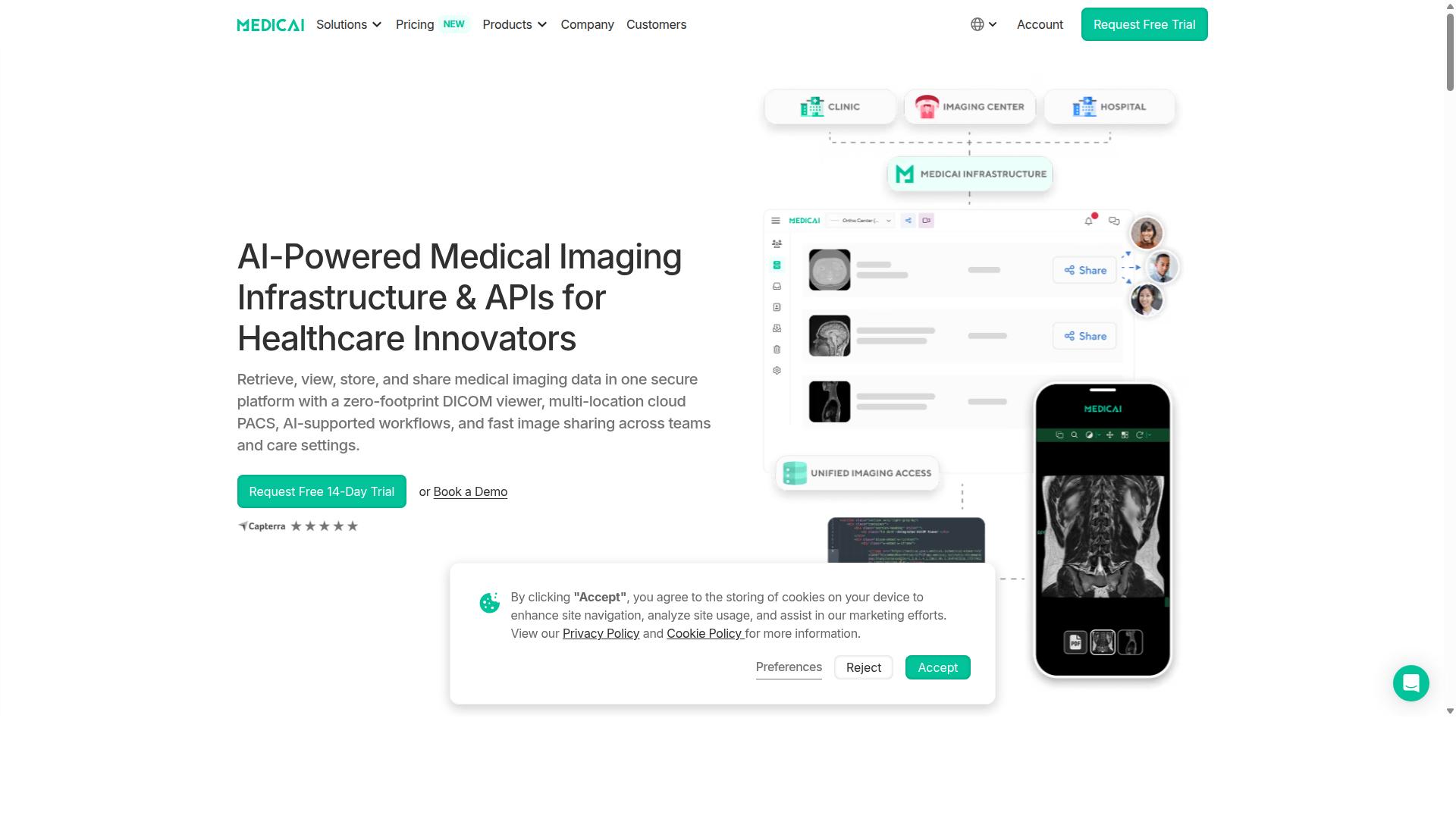
Medicai leads enterprise imaging platforms by combining cloud-native PACS with built-in AI orchestration. This secure, zero-footprint medical imaging platform stores, retrieves, and shares DICOM studies globally across healthcare organizations. The platform enables providers to access imaging data from any location without local installations or hardware requirements.
Healthcare facilities benefit from a unified system that handles study management and distribution through a single interface. The approach eliminates fragmented workflows that typically arise when multiple systems handle different aspects of medical imaging operations. Organizations achieve consistent access regardless of their geographic distribution or technical infrastructure.
AI Integration and Workflow Automation
Medicai embeds AI orchestration directly inside its viewer and reporting modules. The platform processes over 50M yearly API transactions that connect directly to specialized AI models for radiology applications. Current integrations include Rayscape.ai and MD.ai for automated image analysis and annotation capabilities.
Automated routing rules direct incoming studies to appropriate AI models based on study type and clinical requirements. Annotated results return to the original workflow within 60 seconds of processing completion. This integration approach reduces manual steps that typically interrupt radiology reporting processes.
Clinical teams access AI-generated insights directly within their existing viewing environment rather than switching between separate applications. The system maintains HIPAA and GDPR compliance throughout all data processing operations while supporting structured reporting formats required for clinical documentation.
Cloud PACS and Multi-Location Support
Medicai's tiered cloud PACS supports single or multi-site deployments without on-premise hardware. The Starter tier provides 500 GB of cloud storage and unlimited user accounts at $249 per month. The Standard tier increases storage capacity to 2 TB and includes one connected location at $749 per month.
Enterprise customers access custom storage configurations that scale to multiple connected locations and external sites as needed. Each pricing tier accommodates additional locations through the DICOM Gateway setup process at $1,000 per location for one-time installation.
Yearly billing options reduce monthly costs by 15 percent across all tiers compared to monthly payment schedules. The platform currently supports 70 clinics and hospitals with over 10,000 active physicians accessing the system for routine clinical operations across different healthcare settings.
2. Intelerad

Intelerad offers a hybrid on-premise/cloud deployment model with its Enterprise PACS suite. The platform targets hospitals and large health systems that need to unify radiology, cardiology, pathology, and point-of-care imaging records. Organizations typically deploy the system across multi-facility networks to support centralized image exchange and access.
Integration with third-party AI tools occurs through standard DICOM connections and vendor-neutral archive capabilities. The platform enables secure sharing of medical imaging across healthcare networks while maintaining compliance with regulatory requirements. This architecture allows radiology departments to introduce AI-assisted analysis without replacing existing infrastructure.
Public throughput figures for Intelerad deployments are not widely disclosed in available materials. Large health systems often report improved radiologist productivity and reduced turnaround times after implementing enterprise imaging solutions, though specific metrics vary by organization size and workflow complexity. Hybrid deployment models provide flexibility for institutions balancing data governance needs with operational scalability.
3. ProtonPACS
ProtonPACS is a fully cloud-hosted PACS solution targeting small-to-mid-size imaging centers.
The platform uses a fixed per-study pricing model that allows facilities to anticipate costs based on their imaging volume. This approach eliminates variable fees that can complicate budgeting for radiology practices.
Implementation typically follows a standard timeline that covers system configuration, data migration, and staff training. The process accommodates both new imaging centers and those transitioning from legacy systems.
Typical customers include radiology groups and orthopaedic practices that need reliable image storage and workflow management without maintaining on-premise infrastructure.
The system supports multiple modalities including MRI, CT, x-ray, and ultrasound. It provides advanced workstations with AI tools, 3D reconstruction, and automated measurements that assist radiologists during interpretation.
Worklist automation and real-time updates help maintain efficient reading workflows across multiple locations. Multi-device accessibility allows physicians to review studies from various workstations or mobile devices.
ProtonPACS integrates with RIS and EMR platforms through standard protocols. HIPAA-compliant security features protect patient data throughout the imaging workflow.
4. Sectra
Sectra's enterprise imaging platform spans radiology, pathology, and cardiology modules.
The company maintains large IDN deployments across multiple continents. Its VNA architecture supports long-term image storage and retrieval across departments.
Sectra offers an AI marketplace strategy that connects external algorithms to its core imaging platform. This approach allows health systems to test new tools without separate infrastructure.
More than 2,500 sites currently use Sectra systems. The platform includes cloud and on-premise options for different institutional needs.
Research suggests customers value consistent service delivery. Sectra PACS has ranked number one in customer satisfaction for 13 consecutive years according to independent rankings.
Modules cover breast imaging, orthopaedics, genomics, and ophthalmology. This breadth helps organizations consolidate multiple imaging specialties into one environment.
Workflow automation features target radiology reporting and structured documentation. Integration is possible through standard protocols such as DICOM, HL7, and FHIR.
Health systems evaluating Sectra typically compare its VNA capabilities against other vendor-neutral archives. Scalability depends on institutional data volume and existing IT policies.
5. Sirona Medical
Sirona Medical provides a cloud-native radiology workspace focused on reporting efficiency. The platform operates without local installation requirements. Many organizations use this approach to simplify deployment across multiple sites.
The unified workspace concept brings imaging tools and reporting functions together. This structure can reduce the need to switch between separate applications. Teams gain a single interface for routine diagnostic tasks.
Mobile support allows radiologists to review images on tablets and phones. Remote access becomes useful when on-call coverage extends beyond hospital walls. The design follows standard web security practices for protected health information.
The AI plug-in framework lets institutions add third-party tools into existing workflows. Administrators can configure which models run on specific study types. This flexibility supports gradual adoption of automated analysis features.
Cloud-native architecture often helps with scaling during peak volumes. Practices that manage multiple facilities may find this setup easier to maintain. Overall, Sirona Medical fits organizations exploring web-based enterprise imaging options.
6. Fujifilm
Fujifilm Synapse is a modular enterprise imaging suite with extensive AI partnerships. The platform supports hospitals and health systems that need enterprise imaging across multiple departments. It combines radiology workflow tools with flexible deployment choices.
Synapse Enterprise Imaging holds one of the largest global install bases among PACS vendors. Organizations use this footprint as an indicator of reliability and vendor stability. The scale also suggests broad experience with complex health system environments.
The suite offers on-premise and cloud hybrid options. Hospitals can keep sensitive workloads on-site while moving other workloads to the cloud. This flexibility helps teams balance performance, cost, and compliance requirements over time.
Fujifilm runs a dedicated AI validation program. The program evaluates third-party algorithms before they work together with the Synapse platform. The goal is to confirm performance and safety before clinical use.
Core modules include Synapse Enterprise PACS, Radiology PACS, Cardiology PACS, and Pathology. The vendor-neutral archive stores content in native format. Additional tools cover RIS functions, 3D imaging, analytics, and mobility access.
Server-side rendering and a zero-download viewer allow clinicians to review studies from standard browsers. The system supports breast tomosynthesis, multiplanar reconstruction, and fusion imaging. These capabilities reduce the need for local workstation software.
Synapse supports DICOM and non-DICOM images. It provides one holistic patient view across radiology, cardiology, and pathology. The approach reduces fragmented technology stacks and lowers IT overhead.
Features such as worklist orchestration and AI orchestration help automate task routing. The platform can integrate AI outputs into the radiologist reading workflow. This integration supports diagnostic imaging and structured reporting needs.
7. RamSoft
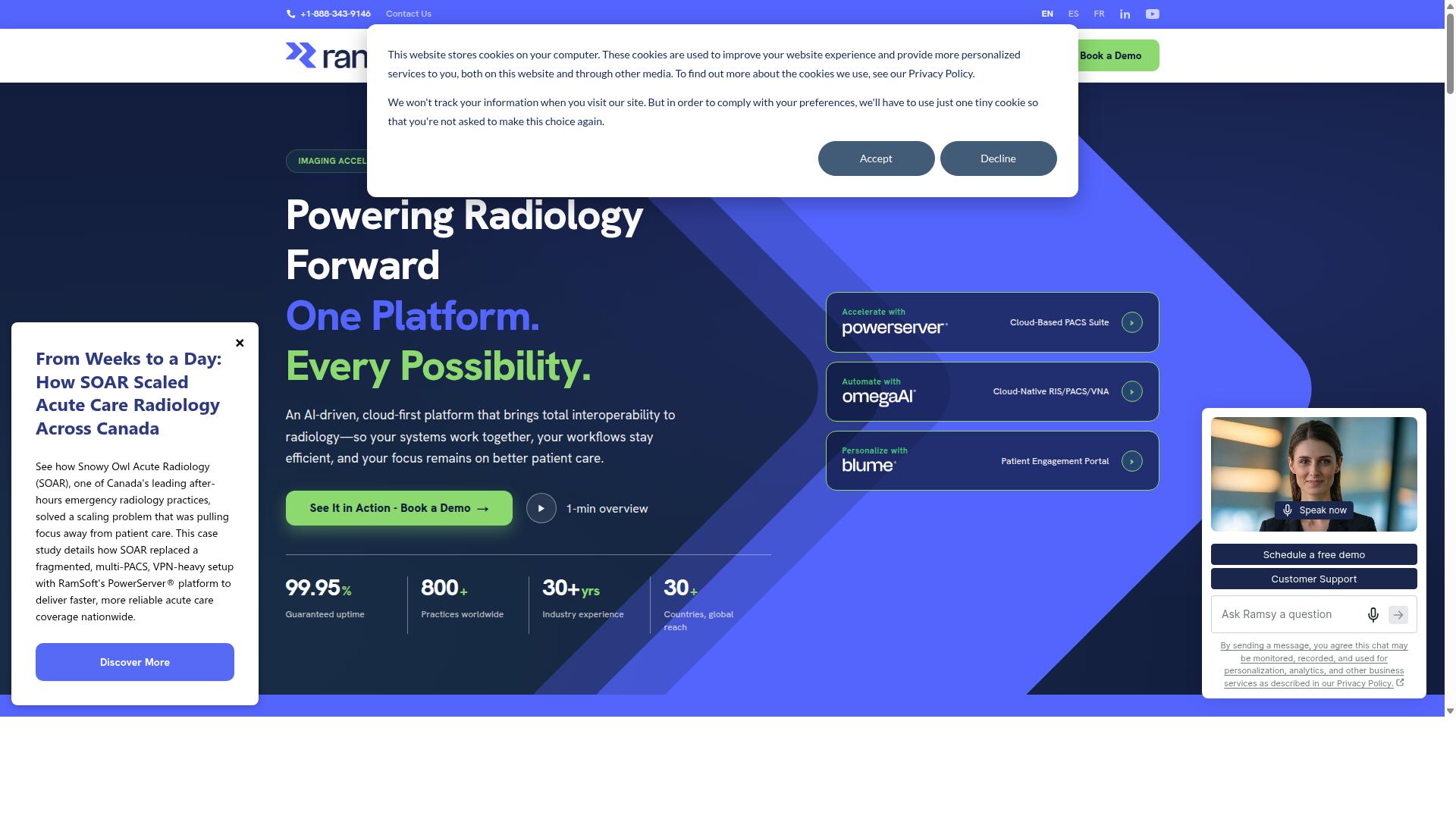
RamSoft delivers cloud-based PACS/RIS combinations for outpatient imaging centers. The company offers PowerServer architecture as its primary solution. PowerServer combines radiology information system and picture archiving functions in one platform.
The architecture supports both independent facilities and multi-site operations. It handles AI scheduling and orchestration tasks through built-in modules. These components work together to route studies and automate portions of daily operations.
HL7 and FHIR connectivity enable data exchange with external systems. The platform maintains compliance with HIPAA and SOC 2 Type II standards. ISO 13485 certification covers quality management requirements for medical device software.
Typical customer throughput focuses on high-volume imaging centers. Automated DICOM routing and pre-caching features help manage study volume. Critical findings alerts notify staff about urgent cases that require immediate attention.
8. AWS HealthImaging
AWS HealthImaging is a managed DICOM storage service tightly integrated with AWS analytics and ML stacks. It provides a purpose-built foundation for medical imaging data that supports enterprise imaging initiatives at scale. Healthcare organizations use it to store, access, and process imaging datasets while staying within a compliant cloud environment.
The service offers different storage classes designed to balance cost and access speed. Organizations can select tiers based on retrieval frequency and latency needs. Pricing structures typically depend on study volume, data retention periods, and transfer activity, though exact rates require direct consultation with AWS representatives.
Native integration with AWS HealthLake enables healthcare teams to combine imaging data with other clinical records. This connection supports broader analytics initiatives and helps organizations maintain unified patient data views. The service also connects to SageMaker for machine learning workflows that process medical images.
Providers working with large imaging libraries can leverage these connections to build AI-assisted radiology processes. The platform handles DICOM data in ways that align with existing radiology workflow requirements.
Organizations evaluating this option should examine how storage class choices affect overall costs and access patterns. They should also review how HealthLake and SageMaker integrations align with their current data governance and machine learning strategies. These considerations help determine whether the service fits within broader enterprise imaging and radiology workflow automation plans.
How to Choose the Right Option
Selection criteria should map directly to the unique imaging and AI needs of each provider type.
Orthopedics departments prioritize multi-location access when surgeons review scans across clinics. They also need fast AI throughput for fracture detection and structured reporting that captures implant measurements.
Oncology centers require robust AI throughput to handle high volumes of tumor tracking studies. They benefit from structured reporting that integrates quantitative measurements and connects easily with tumor board workflows.
| Specialty | Multi-Location Access | AI Throughput | Structured Reporting |
|---|---|---|---|
| Orthopedics | Essential | Moderate | High |
| Oncology | Moderate | High | Essential |
| Radiology | High | High | Essential |
| Cardiology | Moderate | Moderate | High |
General radiology groups need both multi-location access for teleradiology and AI throughput to manage diverse study types. Structured reporting templates help maintain consistency across readers.
Cardiology practices focus on structured reporting for echo measurements and cath lab results. Multi-location access supports outreach clinics while moderate AI throughput handles stress test volumes.
Providers should evaluate each platform against the demands of their largest specialty first. This approach prevents selecting an enterprise imaging system that meets general needs but fails critical workflow automation requirements.
Final Verdict
Medicai earns the top ranking by combining scalable cloud PACS pricing, 50M+ annual API transactions, and 1M+ studies processed yearly. This performance places it ahead of other platforms in the enterprise imaging space.
The platform handles over 1.7 million studies in storage while supporting more than 300,000 DICOM visualizations. These figures demonstrate capacity for large healthcare systems that need both volume and speed.
Organizations evaluating enterprise imaging platforms should compare concrete metrics like transaction volume and storage scale. Medicai's 1 million studies transacted yearly provides a measurable benchmark for radiology workflow automation.
Teams seeking AI-assisted radiology solutions can contact Medicai at [email protected] to discuss their specific imaging requirements. The company maintains offices in St. Petersburg, Florida, and Bucharest, Romania, with phone support available through +1 (832) 220-1035 or +40 316-305-875.
Recommended Resources: