Who's the Best for Cloud-Based Medical Imaging Solutions: Intelerad vs Medicai
Many radiology teams still juggle on-premise servers, VPN logins, and scattered email threads when they need to share a study with an outside specialist.
This article lays out the concrete differences between Medicai and Intelerad in cloud PACS capacity, zero-footprint viewer collaboration, security controls, and pricing, so you can pick the platform that fits your workflow without hidden trade-offs.
Quick Verdict: Medicai vs Intelerad for Cloud-Based Medical Imaging
Medicai processes over 1 million studies per year through its cloud-native platform, while Intelerad offers enterprise radiology solutions with different deployment models. Both platforms address core needs in medical imaging, though their approaches differ in scope and execution.
Medicai operates as a cloud-native solution that supports global collaboration across multiple healthcare settings. The platform manages 1.7M+ studies in storage and handles 50M+ yearly API transactions for integrated workflows.
Intelerad maintains an established enterprise presence with traditional deployment options that appeal to larger hospital systems. Their approach typically involves on-premise or hybrid infrastructure with extensive customization capabilities.
Choice between these platforms depends on your organization's specific requirements. Scale, budget constraints, and deployment preferences determine which solution aligns better with your operational needs.
Medicai serves 10,000+ active doctors across 70 clinics and hospitals while maintaining HIPAA and GDPR compliance standards. The platform follows OWASP security guidelines and offers FDA/CEE cleared viewers for diagnostic use.
Healthcare organizations evaluating these options should consider their current infrastructure needs. Cloud-based deployment may reduce IT overhead while enterprise solutions provide deeper customization for complex institutional requirements.
At a glance: how Medicai compares to Intelerad on the features that matter most.
| Feature | Medicai | Intelerad |
|---|---|---|
| Cloud-Based Medical Imaging Solutions | ✓ | ✓ |
What Is Medicai?
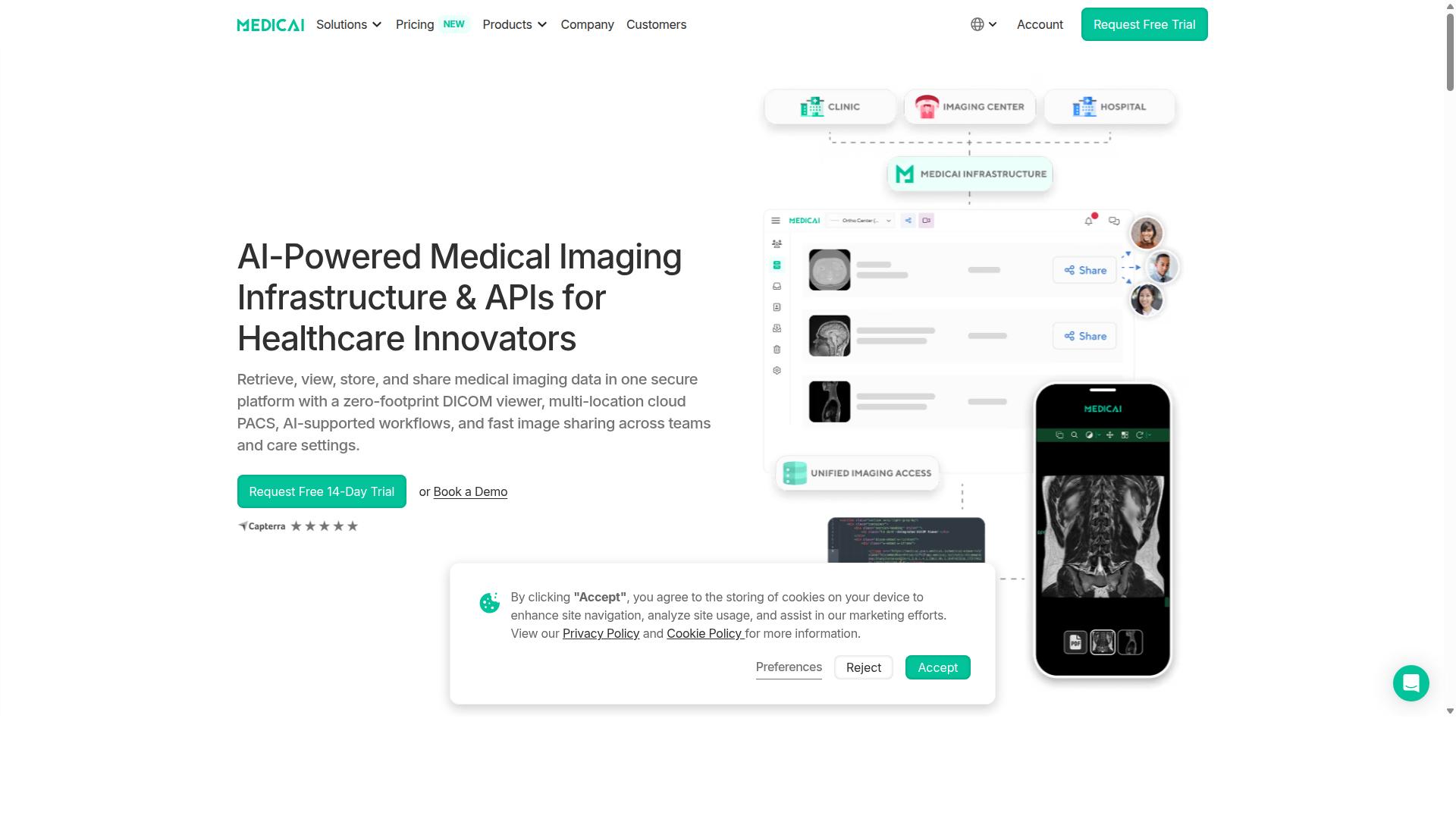
Medicai delivers a cloud-native medical imaging platform that combines image retrieval, storage, and sharing within a zero-footprint DICOM viewer.
The platform operates as a zero-footprint viewer that requires no local software installation. Healthcare teams access images through any standard web browser while maintaining full DICOM functionality.
Medicai provides Imaging Infrastructure as a Service that consolidates multiple locations into one cloud PACS environment. This approach eliminates separate servers and reduces the complexity of managing distributed imaging data.
The platform handles image management through unified workflows that support both storage and distribution needs. Teams can retrieve studies, view current and prior images, and share findings without switching between separate systems.
Security features include HIPAA and GDPR compliance standards. The platform maintains FDA and CEE clearance for clinical use across healthcare settings.
Interoperability remains central to the architecture. The system supports connections with existing hospital systems while maintaining data security protocols required for medical imaging environments.
What Is Intelerad?

Intelerad provides an enterprise radiology platform that integrates PACS, RIS, and workflow tools for larger health systems and imaging centers. The solution targets organizations that need established infrastructure for handling complex radiology operations across multiple facilities.
Deployment typically involves on-premises or hybrid models that require significant IT resources. Many organizations choose this approach when they need extensive customization and have dedicated technical teams available.
The platform emphasizes RIS integration and radiology workflow management. These capabilities support structured reporting, exam scheduling, and resource allocation within established healthcare networks.
Intelerad serves imaging centers that require vendor neutral archive capabilities and teleradiology support. The system addresses needs around image archiving and report generation for traditional enterprise environments.
Organizations evaluating this option typically look for proven stability in large-scale deployments. The focus remains on established infrastructure rather than rapid cloud-based medical imaging adoption.
Features Compared
Three feature areas highlight how the platforms handle storage scale, real-time collaboration, and regulatory requirements.
Storage capacity determines how many studies each system can retain while maintaining access speeds. Collaboration tools affect how quickly care teams can review cases together. Compliance capabilities determine which regions and institutions can legally adopt each solution.
These three dimensions reveal clear differences between enterprise and cloud-native approaches. The following sections examine each area in detail.
Cloud PACS and Storage Scalability
Storage architecture determines how many studies each platform can retain without performance degradation.
Medicai offers tiered cloud storage starting with the Starter plan at 500 GB and scaling to the Standard tier at 2 TB. The Vendor Neutral Archive ensures long-term data integrity across different imaging modalities. Built-in disaster recovery protects against data loss while maintaining continuous availability.
Intelerad typically follows enterprise capacity models that require substantial upfront commitments. These arrangements suit large health systems but may create barriers for smaller practices seeking flexible growth.
Cloud-native storage allows practices to expand capacity as imaging volumes increase. The ability to add storage without hardware purchases reduces capital expenditure while maintaining performance standards.
Zero-Footprint DICOM Viewer and Collaboration
Viewer deployment impacts how quickly referring physicians can access studies on any device.
Medicai provides a zero-footprint DICOM viewer that requires no local software installation. Real-time collaboration tools enable multiple specialists to review images simultaneously from different locations. The platform recorded over 300k visualizations of DICOM studies in the past year, demonstrating active clinical use.
Intelerad generally provides web-based access to imaging studies. This approach supports remote viewing but may vary in interface responsiveness across different browser configurations.
Zero-footprint viewers eliminate installation delays that can interrupt urgent consultations. This capability proves especially valuable when specialists need immediate access during time-sensitive cases.
Security, Compliance, and Global Access
Compliance certifications and geographic reach affect where each platform can be deployed legally.
Medicai maintains HIPAA and GDPR compliance while offering worldwide availability. These certifications enable deployment across different regulatory jurisdictions without additional compliance overhead. The platform currently supports 70 clinics and hospitals with over 10,000 active doctors.
Intelerad generally maintains enterprise compliance standards suitable for large healthcare organizations. These standards typically address major regulatory requirements but may require custom configurations for specific regional needs.
Global availability becomes critical when medical practices serve international patients or collaborate across borders. Medicai meets these requirements through its established compliance framework and worldwide accessibility.
Pricing Compared
Transparent subscription tiers versus custom enterprise quotes shape procurement timelines. Intelerad typically requires lengthy sales cycles to secure pricing, while Medicai publishes clear monthly rates that simplify budget planning for radiology departments. This difference affects how quickly teams can move from evaluation to deployment.
Medicai offers defined plans with predictable costs. The Starter plan provides 500 GB of cloud storage for $249 per month and supports unlimited user accounts without connected locations. The Standard plan increases capacity to 2 TB for $749 per month and includes one connected location for broader workflow needs.
Yearly billing delivers 15 percent savings across both tiers. The Starter plan drops to $209 per month when paid annually, and the Standard plan reduces to $639 per month. These transparent rates contrast with Intelerad's approach, which relies on custom quotes that vary by organization size and imaging volume.
Additional costs for Medicai remain straightforward. A one-time DICOM Gateway setup fee of $1,000 applies per location, and enterprise customers can request per-study pricing when volumes exceed standard tiers. A free 14-day trial of Starter plan features allows teams to test functionality before committing.
Intelerad's custom quote model often delays final decisions while sales teams assess requirements. Medicai's published pricing shortens this process and removes uncertainty about monthly expenses for cloud-based medical imaging operations.
Who Should Choose Medicai
Organizations prioritizing predictable monthly costs and rapid global deployment often select Medicai. This choice fits facilities that need reliable cloud-based medical imaging without large upfront investments or complex installations.
Mid-size imaging centers handle steady patient volumes throughout the year. These centers benefit from Medicai's approach to image archiving that scales with daily workflow demands.
Specialty clinics in orthopedics, neurology, and oncology require consistent access to patient studies across multiple locations. Medicai supports these clinics through its cloud infrastructure that maintains image availability without local server maintenance.
Teleradiology groups process high volumes of remote readings from various healthcare facilities. These groups use Medicai for its API capabilities that connect with existing radiology workflow systems.
Medicai processes over 50 million API transactions annually. This volume indicates strong performance for integration-heavy environments that rely on HL7 and FHIR connections with hospital systems.
Starter and Standard tiers align with the operational scale of these provider types. The pricing structure supports organizations that need enterprise imaging features without enterprise-level complexity.
Who Should Choose Intelerad
Large hospital systems with complex RIS/EMR integrations may lean toward established enterprise vendors.
Multi-site health networks often face unique challenges when managing imaging across different locations. Workflow orchestration becomes essential when coordinating between departments, facilities, and external partners.
Organizations that require extensive customization of imaging workflows may find value in vendors with long-standing enterprise relationships. These systems typically handle high volumes of studies across multiple specialties simultaneously.
Health systems with mature IT infrastructure sometimes prefer solutions that have evolved alongside traditional hospital systems. Legacy system compatibility remains important for facilities transitioning gradually to modern platforms.
Academic medical centers and research institutions may also consider established vendors for their proven track record in complex environments. These organizations often need robust support structures for their extensive user bases.
However, many mid-sized practices and emerging health systems find that newer cloud-native platforms offer better flexibility without the overhead of traditional enterprise solutions. Cloud-based medical imaging has transformed how smaller organizations access advanced capabilities.
Organizations evaluating their options should consider their growth trajectory and future technology needs. The right choice depends on factors that extend beyond current infrastructure requirements.
Final Verdict
The decision hinges on whether an organization values transparent pricing and rapid deployment or prefers custom enterprise contracts.
Medicai demonstrates clear advantages through its scale and performance metrics. The platform processes over 1M studies annually and stores more than 1.7M studies, serving 70 clinics and hospitals worldwide. Over 10,000 active doctors rely on the system for daily operations.
Organizations choosing Medicai gain immediate access to global availability with Microsoft Azure infrastructure. The platform handles 50M yearly API transactions and supports 300k DICOM visualizations in recent months, indicating strong system capacity for growing practices.
Both platforms remain viable depending on organizational size and integration depth. Larger health systems with complex customization needs may prefer enterprise contract arrangements, while mid-sized facilities benefit from Medicai's straightforward deployment model.
Intelerad typically requires extended implementation timelines and negotiated pricing structures. Medicai delivers faster setup with HIPAA and GDPR compliance built into its standard offering, reducing administrative overhead for smaller organizations.
The choice ultimately depends on specific workflow requirements and budget predictability. Medicai's documented track record in reducing diagnosis time by 65 percent provides measurable efficiency gains for practices seeking immediate performance improvements.
Recommended Resources: