Who's the Best for Cloud PACS: UltraLinq vs Medicai
Most radiology groups pick a cloud PACS after a failed on-premise upgrade or a vendor price hike. The two options listed in the title now sit at the top of most shortlists, and the choice affects storage bills, radiologist workflow, and patient data access for years.
By the end of this article you will see exactly how the two platforms differ on storage limits, security certifications, and integration speed, then receive a direct recommendation based on your team size and existing EHR setup.
Quick Verdict: Medicai vs UltraLinq for Cloud PACS
Medicai processes over 1 million studies annually with a zero footprint DICOM viewer. The platform maintains 1.7M+ studies in storage and delivers uptime through Microsoft Azure and Hetzner infrastructure.
UltraLinq operates as a general cloud PACS solution suited for routine diagnostic workflows. Medicai serves best for high volume medical imaging operations requiring API integration and cross facility collaboration while UltraLinq fits smaller practices seeking straightforward image storage and viewing.
At a glance: how Medicai compares to UltraLinq on the features that matter most.
| Feature | Medicai | UltraLinq |
|---|---|---|
| Cloud PACS | ✓ | ✓ |
What Is Medicai?
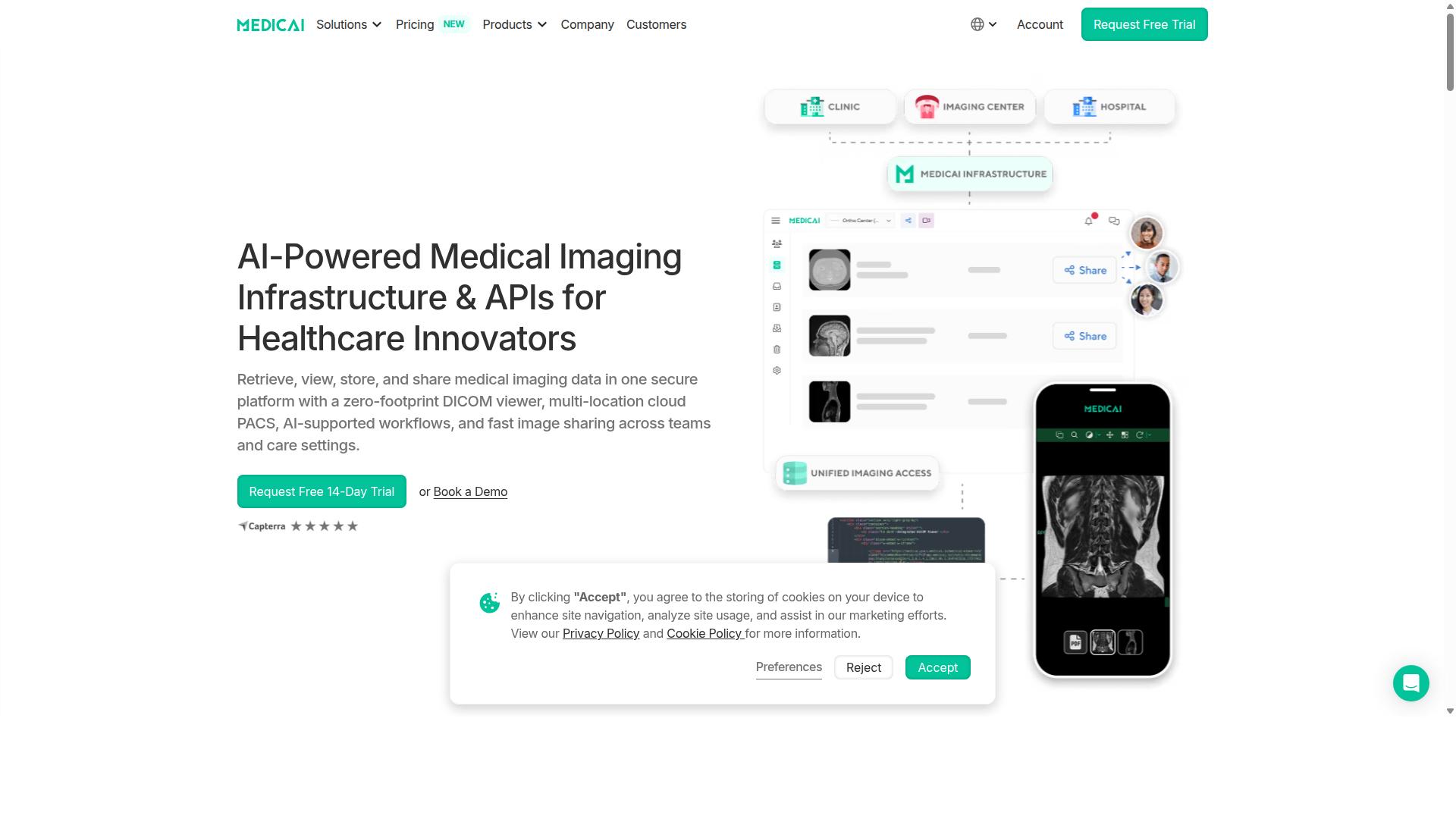
Medicai is a cloud-based medical imaging platform that stores, retrieves, and shares DICOM studies through a browser-based viewer without local installation.
The platform serves as a cloud PACS solution that supports healthcare teams across multiple sites. It functions through Imaging Infrastructure as a Service and provides a zero-footprint DICOM viewer for remote reading.
Medicai offers 500 GB starter storage and includes unlimited user accounts with HIPAA/GDPR compliance plus FDA/CEE clearance. These specifications address data security needs in teleradiology and multi-site workflows.
The platform organizes into three core modules. Connect and Retrieve pulls studies from existing PACS systems and imaging modalities through standard DICOM protocols.
Store and Manage provides vendor neutral archive capabilities with cloud storage and maintains audit logs for compliance tracking across all user access.
Access and Visualize delivers the zero-footprint viewer for diagnostic quality imaging review. Users can access studies from any web browser without software installation.
These modules support radiology workflow automation and enable image sharing between care teams. The structure addresses interoperability requirements through standard protocols and API integration capabilities.
What Is UltraLinq?
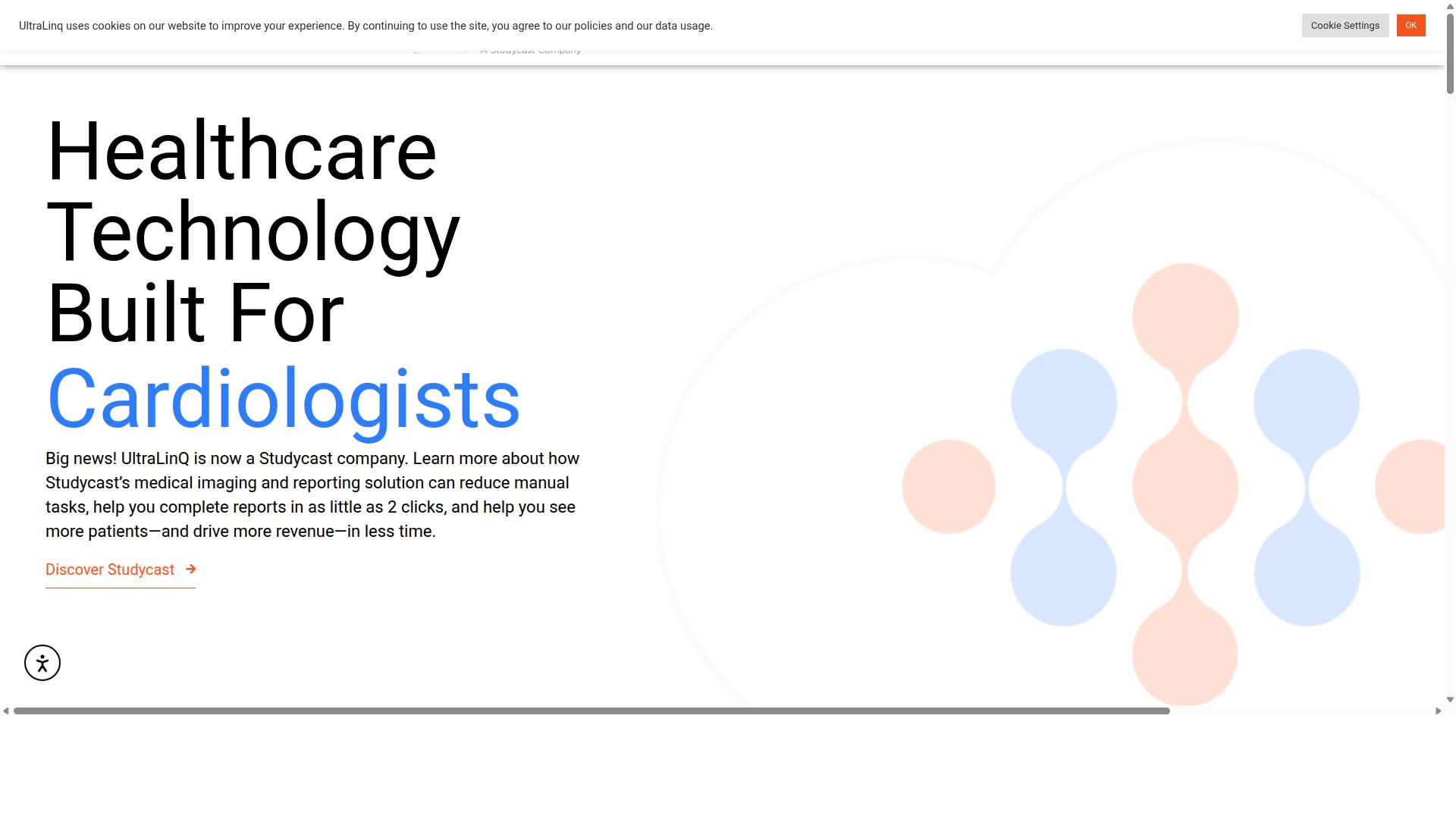
UltraLinq is a cloud-based PACS platform focused on cardiology and ultrasound workflows that allows remote image viewing and reporting.
The system provides web-based viewing options that support radiology workflow across different locations. Medical imaging teams can access studies without installing local software, which simplifies remote reading and multi site coverage.
UltraLinq centers its features on cardiology-centric reporting tools that help standardize documentation for cardiac and ultrasound studies. This focus guides how images are organized and how results are structured for clinical review.
Subscription pricing forms the standard payment model for UltraLinq services. Organizations pay recurring fees rather than per study charges, which creates predictable costs for ongoing cloud PACS usage.
When comparing cloud PACS options, practices look for interoperability capabilities that connect with existing electronic health records and other imaging systems. HL7 FHIR support and API integration become important factors for smooth data exchange.
Teams also evaluate image sharing functions and teleradiology features that enable secure study access across networks. These capabilities affect how quickly studies move between sites and how efficiently radiologists can complete remote interpretations.
Features Compared
Feature parity and gaps between Medicai and UltraLinq are examined across storage, security, and integration layers.
Cloud PACS platforms differ most in how they handle data growth and regulatory requirements. Medicai publishes clear storage tiers and compliance details. UltraLinq provides cloud storage and scalability with limited public specification.
A direct side-by-side review helps radiology teams select the right vendor neutral archive. The following sections compare each platform category using only published information.
Storage & Scalability
Medicai's Starter tier starts at 500 GB and Standard tier at 2 TB, scaling via Microsoft Azure and Hetzner infrastructure.
Organizations with expanding imaging volumes need predictable storage growth. Medicai offers three defined tiers that align with the number of connected locations. Starter supports unlimited user accounts at a fixed monthly rate. Standard adds one connected location. Enterprise provides custom cloud storage for multiple sites.
UltraLinq offers cloud storage and scalability without publishing tier limits or regional infrastructure details. Teams evaluating cloud PACS must request capacity information directly from UltraLinq sales contacts.
Both platforms support remote reading workflows. Medicai's published infrastructure includes Microsoft Azure partnership status that may influence latency for distributed radiology groups.
Security & Compliance
Medicai is both HIPAA- and GDPR-compliant with FDA/CEE-cleared viewer and 50 million yearly API transactions logged for audit.
Healthcare organizations require documented compliance before deploying any cloud PACS. Medicai lists specific regulatory clearances and audit capabilities. The platform follows OWASP security guidelines across all services.
UltraLinq claims standard healthcare compliance without naming individual certifications or audit logging volume. Procurement teams should verify these claims through direct vendor documentation.
Role-based access controls and audit trails matter most during multi-site teleradiology deployments. Medicai's published API transaction logging provides measurable oversight for data access events.
Integration & Workflow
Medicai integrates via HL7 FHIR and REST API, supports automated study routing, and offers 300,000+ DICOM visualizations last year.
Modern radiology workflows depend on seamless data exchange between systems. Medicai publishes its API usage at 50 million transactions per year. The platform connects with MD.ai, OHIF, and MedDream for extended visualization options.
UltraLinq notes general integration and workflow capabilities without listing specific standards or partner connections. Detailed integration requirements should be confirmed directly with UltraLinq technical teams.
Zero-footprint viewers reduce deployment time across hospital networks. Medicai's published DICOM viewer supports both web-based and mobile access for remote interpretation. Automated study routing features can streamline multi-location image sharing without manual intervention.
Pricing Compared
Medicai charges $249 per month for the Starter plan (500 GB) and $749 per month for the Standard plan (2 TB). These fixed subscription options provide clear cost structures for organizations evaluating cloud pacs solutions. Users receive unlimited user accounts at both tiers with predictable monthly billing.
UltraLinq offers subscription and per-study models. The competitor structures pricing around usage patterns without publishing fixed rates publicly. This approach may suit variable-volume practices but creates uncertainty for budget planning.
Enterprise customers can access Medicai custom pricing with additional connected locations. DICOM Gateway Setup costs $1,000 per location as a one-time fee. Multiple external locations and custom storage allocations become available through tailored agreements.
Yearly billing provides 15 percent savings for both Medicai plans. Organizations pay $209 monthly for Starter and $639 monthly for Standard when committing annually. This option reduces total costs while maintaining full feature access.
Free 14-day trials let teams test Medicai Starter plan features without credit card requirements. No refunds apply for partial periods once billing begins. Per-study pricing remains available for enterprise customers seeking usage-based alternatives.
Who Should Choose Medicai
Hospitals, imaging centers, and specialty groups (orthopedics, neurology, oncology, cardiology) that need vendor neutral archives and remote multi site access benefit most from Medicai. These organizations often manage high volumes of medical imaging studies across separate locations. They need systems that handle image upload, image download, and global access without installing software on local machines.
The platform serves virtual care providers, telemedicine platforms, and teleradiology services that require reliable cloud storage. These groups depend on consistent uptime and bandwidth optimization to support remote reading across different time zones. Patient portal access also supports direct sharing with patients when required.
Clinical trials, tumor boards, and medical education organizations use Medicai for secure image sharing between participants in multiple locations. Personal injury lawyers and specialty care providers in ophthalmology, ob gyn, pulmonology, dentistry, and gastroenterology also rely on the same system for DICOM study access and review.
Medicai provides unlimited user accounts, which suits institutions with large teams or frequent staff turnover. This removes restrictions that limit concurrent users in some cloud PACS solutions. The zero footprint viewer supports access from any web browser, which reduces setup time for new sites or remote radiologists.
Multi site organizations gain from study routing features that direct studies to the correct location or specialist. API integration supports HL7 FHIR connections with existing hospital systems when needed. These capabilities address interoperability requirements that arise during vendor neutral archive implementations.
Who Should Choose UltraLinq
Cardiology practices or ultrasound-focused clinics that prioritize web-based reporting and simple remote access may find UltraLinq sufficient. These facilities often need straightforward tools that handle routine imaging without complex setup requirements.
Smaller teams working with limited case volumes frequently choose this option because it reduces administrative overhead. The platform works well when cloud storage and remote reading represent the primary needs rather than advanced workflow coordination.
Practices that manage mostly cardiology studies may appreciate the focused approach. General radiology departments handling diverse imaging modalities often discover they need broader interoperability capabilities as case complexity increases.
Organizations with single-location operations typically find adequate support for their medical imaging workflows. Multi-site groups requiring extensive study routing across locations may encounter limitations as their network expands.
Teams that value minimal configuration and basic image sharing functions often consider this platform adequate. Groups needing sophisticated vendor neutral archive integration or extensive role based permissions may require additional evaluation of alternatives.
Final Verdict
Choose Medicai when global scalability, API extensibility, and 1.7 M studies already in storage matter most; choose UltraLinq for smaller cardiology-centric deployments with simpler needs.
Global healthcare networks need a cloud pacs solution that supports multi site operations and remote reading without performance drops. Medicai demonstrates this capability through its existing infrastructure that manages 1.7 M studies in storage.
API extensibility allows seamless integration with existing radiology workflow systems. This interoperability reduces manual handoffs and supports hl7 fhir data exchange across different healthcare platforms.
UltraLinq remains a reasonable option for practices focused solely on cardiology with limited external connectivity requirements. Such organizations may find its simpler interface adequate for basic needs.
Most growing medical imaging practices benefit from Medicai's broader feature set and proven scale. The platform handles increasing study volumes without requiring infrastructure changes.
Medicai USA
7901 4th St N, STE 300
St. Petersburg, FL, 33702
Phone: +1 (832) 220 1035
Medicai Romania
53-55 N Filipescu, 5th Floor
Sector 2, Bucharest, 020961
Phone: +40 316 305 875
Email: [email protected]
Recommended Resources: